
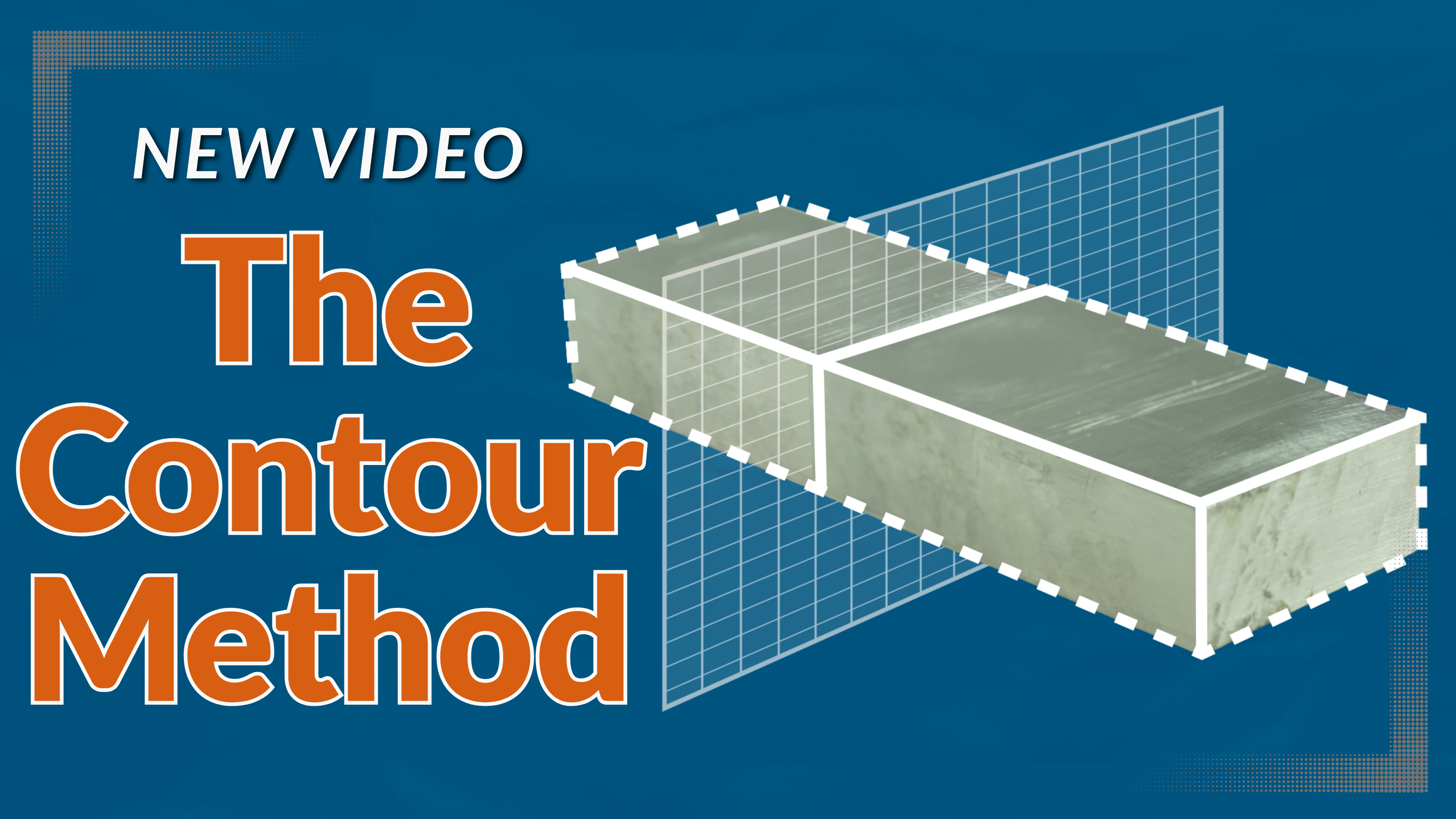
Understanding residual stress is essential to predicting how manufactured components will perform in the real world. To help engineers and manufacturers better understand one of the industry’s most powerful measurement techniques, Hill Engineering has released a new video exploring the Contour Method for residual stress measurement in detail.
The Contour Method provides a two-dimensional map of residual stress across a section of a component, making it particularly valuable for investigating complex stress distributions. The technique works by carefully sectioning a part, measuring the deformation that occurs when residual stresses are released, and using finite element analysis to determine the stresses that existed before the cut. This approach allows engineers to visualize bulk residual stress fields that can be difficult to characterize using other measurement methods.
Our new video walks viewers through this process and explores the types of engineering challenges for which the Contour Method can be especially useful. Take a look below:
The Contour Method is one of Hill Engineering’s most commonly used residual stress measurement techniques, and our team has extensive experience applying and advancing the method.
Watch our new video to learn how the Contour Method works, what makes it unique, and how residual stress measurements can help you better understand the performance of your components.
Subscribe to our YouTube channel for videos about the various residual stress measurement methods. If you have any questions about the Contour Method and how it can benefit your manufacturing processes, please contact us.
Leave a Reply