
Tag: contour method
-

HE measurement data presented at upcoming ICRS 12
Hill Engineering recently performed various residual stress measurements on nickel and aluminum specimens to support a project from the Materials & Processes Engineering group at Pratt & Whitney. The results will be presented by Pratt & Whitney at the International Conference on Residual Stress, happening October 20-23, 2025, in Detroit, MI. If you are planning…
-
Legacy Post: How We Work (Mar 2017)
Maintaining the high quality of our work is our top priority. That’s why it’s important that our office environment promotes efficiency and qualitative communication here at Hill Engineering. From a project’s inception until its close, we strive to keep a workflow that handles our customer’s needs with consistent attention and care. At the moment a…
-

Legacy Post: Cold expansion (Feb 2017)
Fatigue is one important failure mode that guides the design and engineering of aircraft structure. As we have discussed previously aircraft are often manufactured using rivets and fasteners, which require drilling many holes in the structure during assembly. The holes act as stress concentrations, which tend to be locations where fatigue cracks are found. Compressive…
-

Legacy Post: The Prime Room (Feb 2017)
Hill Engineering recently moved into a new facility in Rancho Cordova, CA. The new facility features a combination of laboratory, research and development, and office space; all of which are important as we work tenaciously to meet the needs of our current projects, while at the same time keeping an eye towards innovation and new…
-

Legacy Post: Residual stress in linear friction welds (Dec 2016)
In a previous blog post we discussed, in general, issues related to residual stress in welding. In this post, we’ll follow up with a more detailed look at a specific welding application – linear friction welding of titanium alloys. Titanium alloys are widely used in aerospace applications for their high strength to weight ratio, good…
-
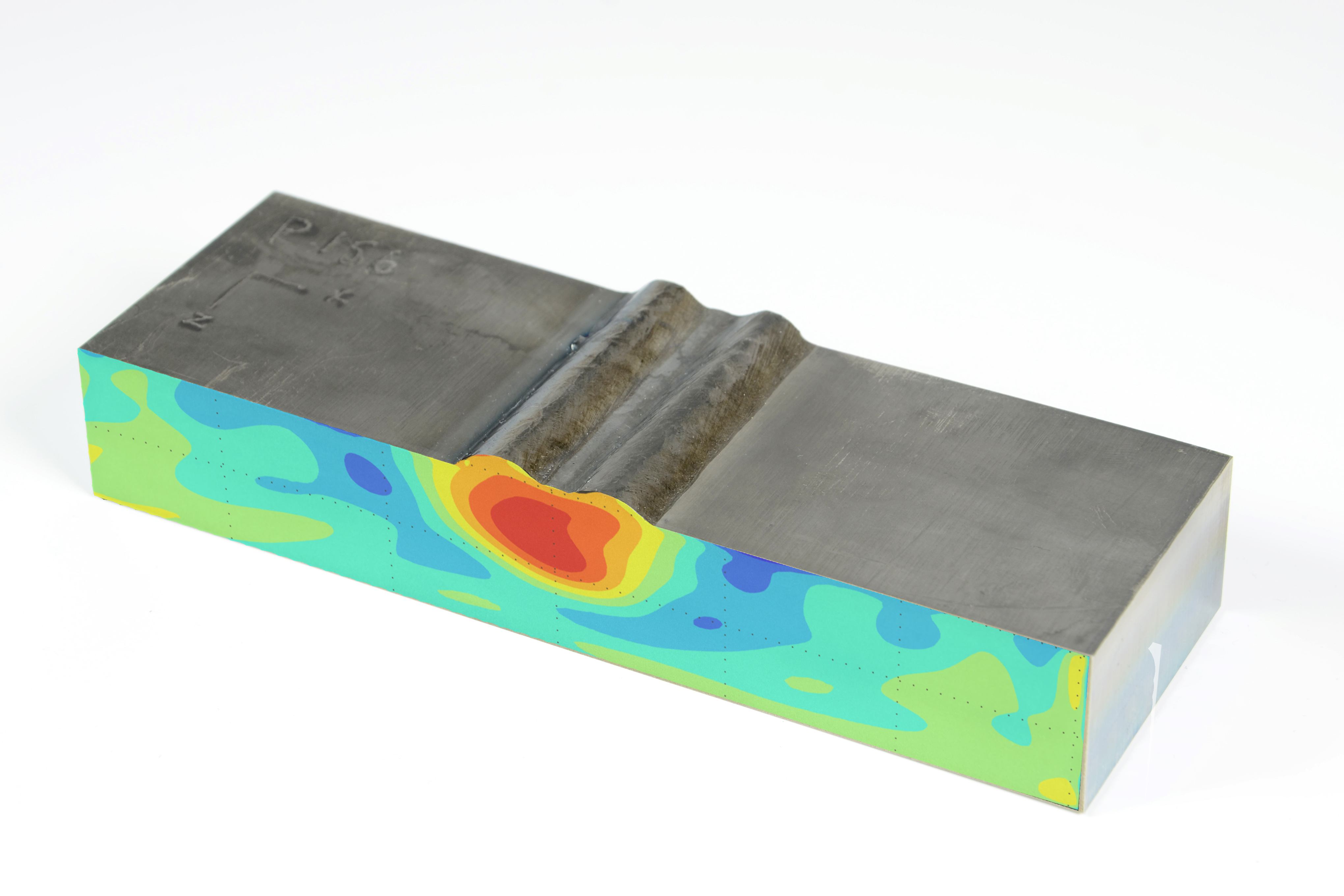
Legacy Post: Residual stress in welding (Sep 2016)
Welding is a very common manufacturing process that is used to join materials together to form assemblies and systems. In many cases the welded joints are large, have reduced material properties (e.g., stress corrosion cracking resistance, fracture toughness), and contain defects. The welded joints tend to be critical locations in terms of design and sustainment.…
-
Legacy Post: Happy Birthday to the Contour Method! (Aug 2016)
Today marks a major milestone in the field of residual stress measurement. The contour method, one of the most useful and advanced residual stress measurement techniques, was first successfully implemented on this date (August 16th) in 1999 by Mike Prime at Los Alamos National Laboratory. The most significant feature of the contour method is its…