
Tag: fatigue
-

Legacy Post: How Tensile Testing Works: A Brief Introduction to Material Strength Testing (Aug 2017)
A tensile test is a standard method used by material scientists and engineers to determine important material strength and ductility properties. For example, tensile tests can be used to measure the yield strength of a material, which is defined as the stress at which a material begins to deform plastically. Hill Engineering has ample experience…
-
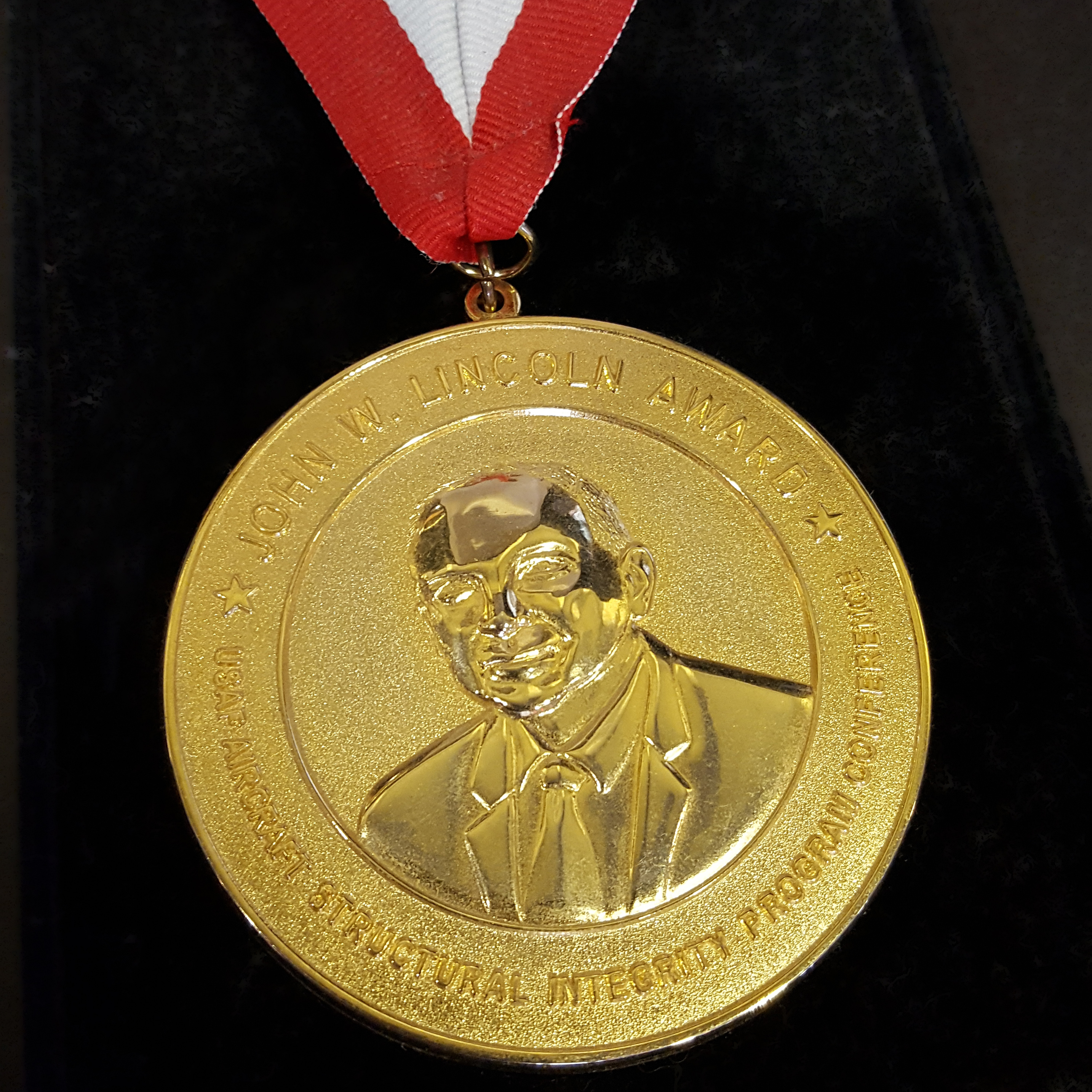
Legacy Post: Lincoln Award (July 2017)
The Lincoln Award is named in honor of Dr. John W. (Jack) Lincoln, the U.S. Air Force’s first Technical Advisor for Aircraft Structural Integrity. An internationally recognized expert in structural integrity, fatigue analysis, and aviation safety, Dr. Lincoln is credited with developing the Aircraft Structural Integrity Program (ASIP) that is now institutionalized throughout the Air…
-

Legacy Post: Understanding Fatigue Analysis for Structural Durability (Apr 2017)
Fatigue is a material failure mechanism whereby repeated sub-critical loads nucleate and grow cracks that can ultimately lead to failure of a structure. Hill Engineering routinely performs fatigue analysis to quantify and predict fatigue performance of materials. State-of-the-art fatigue analysis is subdivided into categories, including durability (crack initiation) or damage tolerance (crack growth). The appropriate…
-
Legacy Post: Failure analysis of high strength nuts (Jan 2017)
Fracture and fatigue are important material performance issues that Hill Engineering examines on a regular basis. Hill Engineering recently contributed to a publication titled “Investigating and interpreting failure analysis of high strength nuts made from nickel-base superalloy.” The publication includes a detailed review of work performed to understand the failure of these fracture critical nuts.…